


Follow-Up Medication Management Appointment Tips for Better Mental Health
Imagine sitting down for your visit and suddenly forgetting the very side effect that kept you up all night. It is a frustrating experience to leave a session feeling like you didn't quite say what you needed to say. Many people feel a sense of urgency or even anxiety during their brief check-ins, wondering if their treatment is truly on the right track. We understand that your mental health journey is deeply personal; these sessions should feel like a safe, non-judgmental space where your progress is the priority. By using a few strategic follow up medication management appointment tips, you can turn these short encounters into meaningful milestones in your healing process.
You deserve to feel like an active partner in your care rather than just a passive recipient of a prescription. This guide will show you exactly how to master your psychiatric visits by tracking your daily experiences and organizing your questions ahead of time. We will cover practical ways to discuss side effects, ensure your dosage is optimized quickly, and build a stronger connection with your provider. Whether you're meeting in person in Greenville or using a telehealth platform, these tools are designed to help you feel heard, validated, and confident as you move toward a brighter, more stable future.
Table of Contents
Why Follow-Up Medication Management Appointments Are Vital for Your Progress
Starting a new treatment can feel like a leap of faith. You might expect immediate relief, but healing is often a gradual unfolding. Medication management isn't just a clinical task; it's a proactive, data-driven partnership designed to support your mental clarity. Many people assume these visits are simply about getting a refill. That is a common misconception. In reality, the first prescription is just the beginning of a titration process. We use these check-ins to monitor how your body responds, ensuring your safety and preventing long-term side effects through consistent clinical oversight. Gaining a better baseline of understanding psychiatric medications helps you participate more fully in these conversations.
The Goal: Finding Your Therapeutic Window
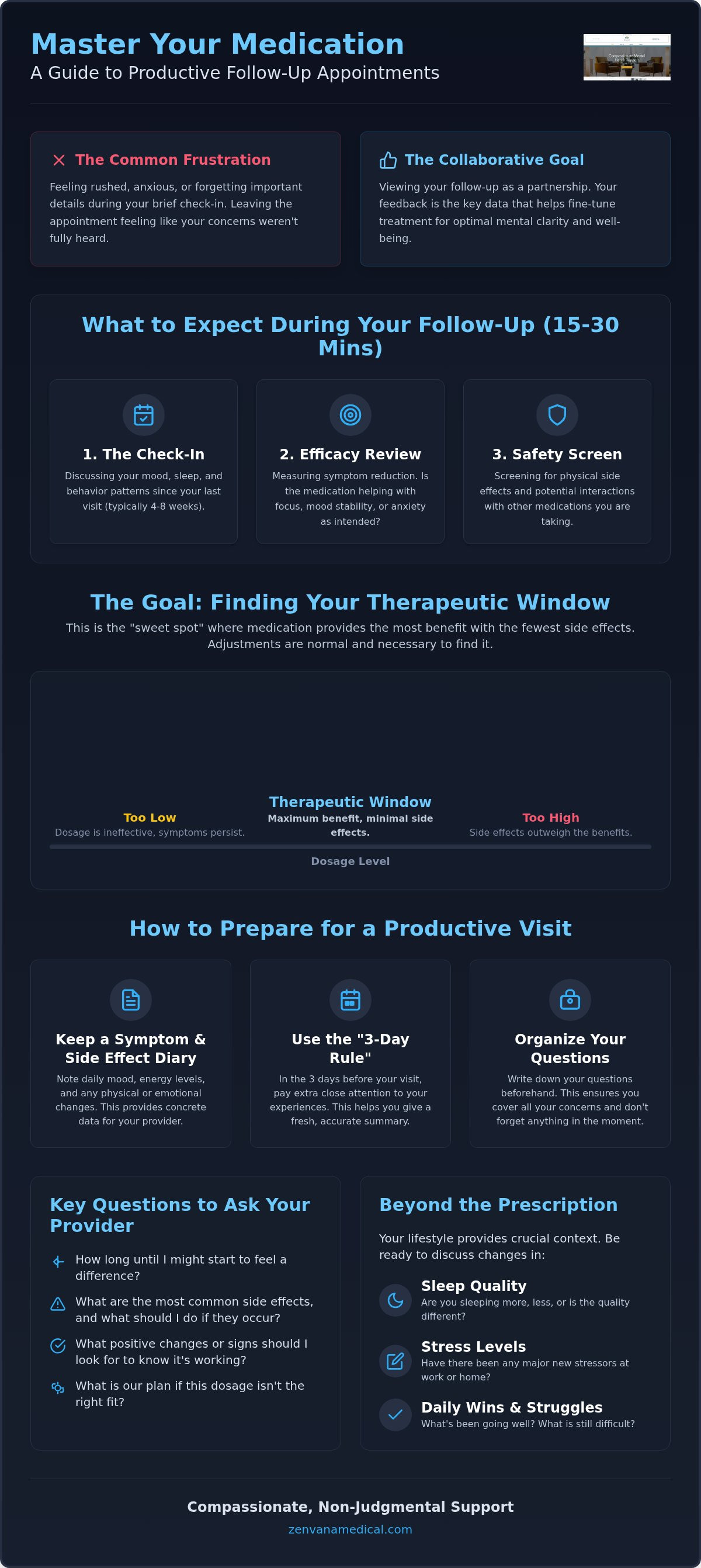
What exactly is a "therapeutic window"? Think of it as the "sweet spot" where the medication provides the most benefit with the fewest side effects. Because every person's biology is unique, follow-up visits help us narrow down that perfect dosage. If you aren't feeling better yet, please don't be discouraged. Adjustments are a completely normal part of the healing path. They don't mean the treatment is failing; they mean we're gathering the data needed to get it right. These sessions are the most effective way to ensure the medication is doing what it's supposed to do without causing unnecessary discomfort.
Beyond the Prescription: A Holistic Check-In
Our conversations go far beyond just pills. Life happens. Changes in your stress levels, sleep quality, or even your diet can impact how well a medication works. During your 20-minute session, discussing these lifestyle factors is essential. You are the true expert on your own internal experience. We rely on your observations to build a more complete picture of your health. Using specific follow up medication management appointment tips, like keeping a brief log of your energy levels, helps us make decisions that honor your whole self. We want to hear about your daily wins and your struggles, as these details are the compass that guides our treatment plan toward your recovery.
It's natural to feel some anxiety if your symptoms haven't vanished overnight. However, these follow-up visits provide the reassurance that you aren't alone in this process. By showing up and sharing your truth, you're taking the most important step toward lasting wellness. We're here to listen, adjust, and walk alongside you as your body and mind find their balance.
What to Expect During a Psychiatric Follow-Up Session
Your initial evaluation was likely a comprehensive, hour-long deep dive into your history and goals. In contrast, follow-up appointments are designed to be focused and efficient, usually lasting between 15 and 30 minutes. This shorter duration doesn't mean your care is being rushed. Instead, it reflects a shift from information gathering to active monitoring. Because the foundation of your treatment plan is already set, these sessions allow us to concentrate on how you're responding to your specific treatment plan in real time. It's a rhythmic check-in that ensures you're moving toward the mental clarity you deserve.
During a standard visit, your provider will guide you through three essential phases. The "Check-In" phase focuses on the last 4 to 8 weeks of your mood and behavior patterns. Next, the "Efficacy" phase measures your current symptom reduction against the baseline goals we established together. We look for improvements in focus, mood stability, or anxiety levels to see if the current plan is working as intended. Finally, the "Safety" phase involves screening for physical side effects or potential interactions with other medications you might be taking. For a broader context on how different treatments function, you can refer to the National Institute of Mental Health overview of mental health medications. Incorporating simple follow up medication management appointment tips can help you track these changes more accurately between visits.
Common Questions Your Provider Will Ask
Preparation is key to making the most of your time. Your provider will often start with an open-ended question like, "How have you been feeling since our last visit?" This isn't just a polite greeting; it's an invitation for you to share your subjective experience. They will also ask specific questions about your physical health, such as changes in your sleep or appetite. You might be asked to rate your symptoms on a scale of 1 to 10. Using these follow up medication management appointment tips ensures you're ready to provide the clear data points your provider needs to help you feel better faster.
Navigating Dosage Adjustments and Tapering
It's common for dosages to change over time. Your provider might increase a dose to reach the therapeutic window or decrease it if your symptoms have stabilized and you're experiencing side effects. Tapering is another common adjustment. If you're moving off a medication, your provider will design a slow, safe reduction schedule to minimize any withdrawal effects. This careful clinical oversight is why these check-ins are so important for your long-term success. Understanding the clinical reasoning behind these changes is vital. Don't hesitate to ask why a change is being made before you leave the session. If you're looking for a supportive partner in your recovery, our team at ZenVana Medical offers personalized care tailored to your specific needs.
Essential Tips for Preparing Your Medication History and Symptom Log
Walking into your session with a clear record of your month can take a huge weight off your shoulders. We know it's hard to remember exactly how you felt three weeks ago, especially when life gets busy. This is where practical follow up medication management appointment tips become your best friend. Start by creating a simple Side Effect Diary. Whenever you notice a new physical sensation or an emotional shift, jot down the time of day and how intense it felt on a scale of 1 to 5. This removes the pressure of having to recall every detail on the spot.
To make the most of your time, try the 3-Day Rule. While we want to know about your whole month, pay extra close attention to the 72 hours leading up to your visit. This snapshot provides a fresh look at your current baseline. It's also vital to list every substance you use. This includes your morning coffee, a weekend glass of wine, daily vitamins, and any over-the-counter allergy meds. These details help us ensure your treatment plan is safe and effective. Don't forget to record your "wins" too. If you finally had the energy to go for a walk or felt less reactive during a stressful meeting, tell us. Tracking what is going well is just as important as identifying the hurdles.
Tracking Tools: Digital vs. Analog
Choosing a method that fits your lifestyle is the key to consistency. If you're always on the go, a simple notes app on your phone works wonders for real-time logging. For our Greenville residents who face a daily commute, try using voice memos to record your thoughts while you drive. It's a productive way to process your day without adding more to your to-do list. If you prefer something tactile, a physical mood calendar allows you to visualize patterns over the course of a month. Seeing your progress laid out in ink can be incredibly validating and helps you spot trends you might otherwise miss.
The Power of Specificity in Reporting
When you share your experience, specificity is your greatest tool. Instead of saying, "I feel bad," try a more detailed approach like, "I felt a spike in anxiety at 3 PM for four days this week." This level of detail helps us pinpoint exactly what might be happening. Regarding your sleep, move beyond "I slept okay." Instead, note how many hours you actually rested and the quality of that rest. Finally, try writing a single sentence that defines your number one goal for the next month. Sharing this goal during your session helps us align your care with your personal vision of health. These follow up medication management appointment tips empower you to be the most effective advocate for your own recovery journey.
Maximizing Your Time: Questions to Ask Your Provider
Walking into a short appointment can feel like a race against the clock. We want to help you slow down that process so you feel truly supported. One of the most effective follow up medication management appointment tips is to arrive with a written list of questions. This simple act ensures that your most pressing concerns aren't lost in the shuffle of a 20-minute visit. Your provider is your ally, and they rely on your curiosity to help fine-tune your path to wellness. By asking the right questions, you shift the dynamic from a routine check-up to a collaborative strategy session for your health.
Start by asking about the timeline of your treatment. You might ask, "When should I expect to feel the full effect of this adjustment?" Knowing whether a change takes days or weeks to manifest helps manage your expectations and reduces the anxiety of "not feeling better yet." It's also vital to clarify how to handle unexpected changes. Ask your provider, "If I experience a specific side effect, should I call the office immediately or wait until our next visit?" Having a clear protocol for communication provides a powerful sense of safety between appointments. Additionally, always inquire about the "Plan B." Asking what the next options are if a current dosage doesn't improve your mood helps you feel like there's always a way forward. Finally, don't forget to ask about lifestyle synergy. Inquire if there are specific habits, like sleep hygiene or dietary changes, that will help your medication work more effectively.
Targeted Questions for ADHD Management
When managing ADHD, the nuances of your daily schedule matter immensely. You might ask your provider how to distinguish if a dose is too high versus not high enough. This clarity helps you identify subtle signs like "zombie-like" feelings or lingering distractibility. Ask what you should do on days when your schedule is significantly different, such as weekends or high-stress workdays. You can also ask how to track executive function improvements more objectively. This might include monitoring your ability to start tasks or manage your time, which provides more concrete data than just a general feeling of focus.
Targeted Questions for Anxiety and Depression
For those navigating mood disorders, the emotional landscape can be complex. It is helpful to ask, "Is this emotional numbness a side effect of the medication or a symptom of the condition itself?" Distinguishing between the two is essential for finding the right therapeutic balance. You may also ask how to tell the difference between the medication working and a natural, temporary mood lift. Understanding this distinction helps you trust the long-term efficacy of your treatment. Finally, ask about the long-term vision for your care. Knowing the general plan for how long you might stay on a medication helps you feel more in control of your journey. If you're ready to experience this level of personalized, collaborative care, schedule your medication management session with our compassionate team today.
Personalized Medication Management in Greenville: The ZenVana Approach
At ZenVana Medical, we believe that your recovery journey should never feel like a series of clinical transactions. Many people come to us after feeling like just another number in a high-volume medical system. Our approach is fundamentally different. We prioritize your emotional safety by fostering a non-judgmental, compassionate space where you are the central focus. We don't just "manage" your symptoms; we partner with you to achieve a state of lasting mental clarity. By applying the follow up medication management appointment tips we have discussed, you can walk into our office or join a virtual session knowing that your voice is the most important tool we have.
We understand that life in the Upstate is busy. Whether you are a professional working in downtown Greenville or a parent managing a household in Simpsonville, finding time for self-care can be a challenge. To make your healing process as seamless as possible, we offer convenient telehealth follow-ups for South Carolina residents. These virtual visits provide the same level of expertise and clinical oversight as our in-person sessions but from the comfort of your own home. This flexibility ensures that your progress remains steady, even when your schedule is demanding. Our commitment to active listening means every minute of your session is dedicated to ensuring you feel heard, validated, and supported.
Healing in a Nurturing Local Environment
Choosing a private practice over a large, sterile medical group offers a level of intimacy and personalized care that is often missing in modern healthcare. Our Greenville team is dedicated to supporting your autonomy. We recognize that you know your body and mind better than anyone else. We respect the unique life stages of our diverse patient base, from young adults to our cherished older populations. This cultural competence and lack of bias allow us to create treatment plans that are as unique as the individuals we serve. We see ourselves as your dedicated allies, working together to integrate your medication into a person-centered path toward well-being.
Getting Started with Your Next Follow-Up
Starting a new chapter in your health journey doesn't have to be overwhelming. We have made our scheduling process simple for both current and new patients. When you prepare for your first follow-up at ZenVana, bring your symptom logs and any questions you have gathered from our follow up medication management appointment tips. Having these details ready allows us to dive straight into the work of optimizing your care. We are here to provide the gentle authority and wisdom you need to navigate your recovery with confidence. Schedule your follow-up medication management appointment at ZenVana today.
Your Journey Toward Mental Clarity and Balance
Healing is a steady process that requires patience and the right support system. By viewing your follow-up visits as a collaborative partnership, you ensure that every adjustment brings you closer to your therapeutic window. Remember that tracking your symptoms and arriving with specific questions are the most effective follow up medication management appointment tips to help you feel heard and supported. These small, consistent steps lead to significant improvements in your daily life and long-term well-being. You are the expert on your own experience, and your feedback is the compass that guides our care.
At ZenVana Medical, we are proud to serve the Greenville and Simpsonville communities with compassionate, non-judgmental psychiatric care. We specialize in creating personalized treatment plans for ADHD, anxiety, and depression that honor your unique biology and lifestyle. You don't have to navigate your recovery journey alone; our team is here to walk beside you with gentle authority and dedicated support. Begin your path to mental clarity with personalized medication management at ZenVana. We look forward to being a part of your new path to health and helping you reclaim your sense of peace.
Frequently Asked Questions
How often do I need follow-up medication management appointments?
Most patients meet with their provider every four to eight weeks during the early stages of treatment. This frequency allows us to monitor your response and make necessary adjustments safely. Once your symptoms stabilize and we find your therapeutic window, visits may transition to every three to six months. Your specific schedule depends on the complexity of your treatment and how quickly your body adapts to the medication.
Can I do my medication follow-up via telehealth in South Carolina?
Yes, you can access your care through our secure telehealth platform if you are a resident of South Carolina. This option is especially convenient for busy families in Greenville or Simpsonville who need consistent clinical oversight without the commute. Telehealth sessions provide the same level of compassionate support and expertise as in-person visits, ensuring your healing journey remains steady and uninterrupted regardless of your location.
What should I do if I forget to take my medication before my appointment?
Please be honest with your provider if you missed a dose on the day of your visit. There is no judgment here; we simply need accurate data to understand how the medication is functioning in your system. Do not take a double dose to "catch up" before the session. Simply note the missed dose in your symptom log so we can discuss any changes in how you've been feeling.
Why is my follow-up appointment shorter than my first psychiatric evaluation?
Your initial evaluation was a deep dive into your history, whereas follow-ups focus on monitoring your current progress. Since the foundation of your treatment is already established, these 15 to 30-minute sessions are designed for efficiency and active fine-tuning. We use this time to review your recent mood patterns and ensure your dosage is optimized, making the most of your time while maintaining high standards of clinical safety.
What if I am experiencing side effects but my appointment is weeks away?
You should contact our office immediately rather than waiting for your scheduled appointment if you experience distressing side effects. Your safety is our absolute priority, and we may need to adjust your plan sooner than planned. While some mild adjustments are normal, any significant physical or emotional changes deserve prompt attention. We are your allies in this process and want to ensure you feel comfortable and secure.
Should I bring my actual medication bottles to the follow-up visit?
Bringing your actual medication bottles or a clear, updated list is incredibly helpful during your visit. This practice ensures we have the exact dosages and brand names on hand to prevent any errors in your record. It also helps us track how many refills you have remaining. Using these follow up medication management appointment tips helps streamline the session so we can focus more on your emotional well-being.
How do I know if my psychiatric medication is actually working?
Improvement often appears as subtle shifts in your daily functioning before you feel a total mood lift. You might notice that you're sleeping better, focusing longer on tasks, or feeling less reactive to stress. We measure success by comparing your current state to the baseline goals we set during your evaluation. Consistent logging helps you see these incremental changes that indicate your treatment is moving in the right direction.
Can I request a dosage change during my follow-up appointment?
Yes, you are encouraged to discuss dosage changes as part of our collaborative partnership. If you feel your current dose isn't providing enough relief or is causing discomfort, we will review your symptom log together to determine the next steps. Incorporating these follow up medication management appointment tips empowers you to advocate for your needs. We will explain the clinical reasoning behind any increase, decrease, or maintenance of your current plan.



Comments